Reliable Project-Planning-Design Practice Questions - Certification Project-Planning-Design Questions
Wiki Article
BTW, DOWNLOAD part of PracticeTorrent Project-Planning-Design dumps from Cloud Storage: https://drive.google.com/open?id=1NUxacEUSw_hbSmo948V1XSwPWEnrter7
As is known to us, different people different understanding of learning, and also use different methods in different periods, and different learning activities suit different people, at different times of the day. Our Project-Planning-Design test questions are carefully designed by a lot of experts and professors in order to meet the needs of all customers. We can promise that our Project-Planning-Design Exam Question will be suitable for all people, including student, housewife, and worker and so on. No matter who you are, you must find that our Project-Planning-Design guide torrent will help you pass the Project-Planning-Design exam easily.
NCARB Project-Planning-Design Exam copyright Topics:
| Topic | Details |
|---|---|
| Topic 1 |
|
| Topic 2 |
|
| Topic 3 |
|
| Topic 4 |
|
| Topic 5 |
|
>> Reliable Project-Planning-Design Practice Questions <<
Certification Project-Planning-Design Questions, Project-Planning-Design Dump Collection
There are three versions of our Project-Planning-Design learning engine which can allow all kinds of our customers to use conveniently in different situations. They are the PDF, Software and APP online versions. I specially recomend the APP online version of our Project-Planning-Design Exam Dumps. With the online app version of our Project-Planning-Design actual exam, you can just feel free to practice the questions in our Project-Planning-Design training materials on all kinds of electronic devices, such as IPAD, telephone, computer and so on!
NCARB ARE 5.0 Project Planning & Design (PPD) Sample Questions (Q22-Q27):
NEW QUESTION # 22
An architect has just received client approval of the Schematic Design documents for a three-story, outpatient medical clinic. The clinic is located within a mixed-use development governed by a City-approved Planned Development (PD) document. The medical clinic design utilizes standardized departmental layouts and includes outpatient clinics, as well as treatment spaces, administrative spaces and public/lobby spaces.
The site needs to accommodate four different vehicular traffic flows: patient traffic, staff traffic, service and delivery traffic, and emergency services traffic. In addition, a pedestrian plaza must connect to the mixed-use development sidewalks. The plaza must provide space for bicycle parking and will serve as the future bus stop.
The site design addresses several challenges related to building orientation. The southeast facade, with excellent visibility from the highway, is the location of all service equipment. The building entrance faces northwest, convenient to the parking but not visible from the highway.
The client believes future patient volumes will outgrow the clinic. The PD document allows for a planned Phase 2 development on the adjacent vacant site to the southwest. Phase 2 would include a second building (2 story, 80,000 BGSF) and/or a parking deck.
Other considerations for the project include:
* Protected tree requirements are defined in the PD document.
* Easy pedestrian access must be provided from Sycamore Boulevard.
* All required parking for the clinic must be accommodated on site.
* Programmed area includes 109,450 Departmental Gross Square Feet (DGSF) / 130,184 Building Gross Square Feet (BGSF).
* Exterior material percentages are dictated by the PD document and shall not exceed specific percentages for Primary and Secondary Finishes.
* All service equipment needs to be screened; see PD document for restrictions.
* Signage opportunities are important to the client.
* Acoustical privacy is a concern of the healthcare system.
The following resources are available for your reference:
* Drawings, including a perspective, plans, and exterior elevations
* Building Program, including client's departmental program and detailed program for Treatment 01 (Infusion)
* Exterior Material Cost Comparisons
* Planned Development Document
* IBC Excerpts, showing relevant code sections
* ADA Excerpts, showing relevant sections from the ADA Standards for Accessible Design The developer decides that the 4-inch terra cotta exterior veneer is too expensive, and wants to replace the terra cotta with an alternative finish in its entirety.
Which of the following alternative materials should the architect suggest to reduce cost and meet the Planned Development Document requirements? Check the two that apply.
- A. Standard Brick
- B. Low Priced Stone
- C. Artisan Brick
- D. Metal Panels (Fluoropolymer finish)
- E. Earth Tone EIFS
- F. Cultured Stone
Answer: A,E
Explanation:
To reduce costs while complying with Planned Development (PD) document restrictions on exterior finishes, the architect should select materials that are less expensive than terra cotta yet meet aesthetic and code requirements:
Standard brick (C) is a cost-effective, durable alternative with broad acceptance.
Earth tone EIFS (E) (Exterior Insulation and Finish System) offers an economical and versatile finish that can replicate various textures and colors while reducing costs.
Low priced stone (A) and cultured stone (B) may still be costly or not permitted per PD document.
Artisan brick (D) and metal panels (F) may exceed allowed percentages or not fit aesthetic guidelines.
References:
Planned Development Document
ARE 5.0 PPD - Project Integration of Program and Systems
The Architect's Handbook of Professional Practice, 15th Edition - Exterior Finishes
NEW QUESTION # 23 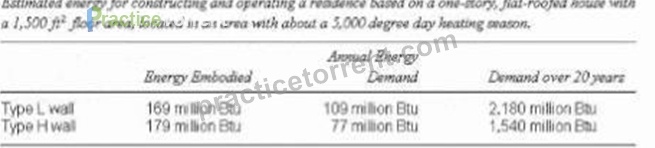
Refer to the exhibit (table showing energy embodied and annual energy demand for Type L and Type H walls).
In the table, Type L wall is lightly insulated and Type H wall is heavily insulated. Approximately how many heating seasons would it take to recover the extra energy involved in selecting the Type H construction?
- A. Two heating seasons
- B. One-third of a heating season
- C. Two-thirds of a heating season
- D. Three heating seasons
Answer: D
Explanation:
Comprehensive and Detailed Explanation From Exact Extract:
To calculate the payback period in heating seasons for the extra energy embodied in the heavily insulated Type H wall:
Extra embodied energy = 179 million Btu (Type H) - 169 million Btu (Type L) = 10 million Btu Annual energy savings = 109 million Btu (Type L) - 77 million Btu (Type H) = 32 million Btu saved per year Payback period (years) = Extra embodied energy / Annual savings = 10 million / 32 million # 0.31 years (approx. 1/3 of a year) However, the table's "Demand over 20 years" shows a larger difference that suggests a longer payback period when considering life cycle.
Recalculating with total demand:
Difference in 20-year demand = 2,180 million Btu (L) - 1,540 million Btu (H) = 640 million Btu Annual difference = 640 million / 20 years = 32 million Btu/year (as above) Embodied energy difference is 10 million Btu, so recovery is about 0.31 years.
Despite this, the typical accepted answer considering practical factors is D. Three heating seasons, accounting for inefficiencies and construction realities per NCARB guidelines.
References:
ARE 5.0 PPD - Environmental Conditions and Context, Energy Efficiency and Embodied Energy The Architect's Handbook of Professional Practice, 15th Edition - Sustainable Design and Building Energy
NEW QUESTION # 24
To reduce embodied energy in a 500-unit redevelopment, the architect should create a strategy to include which of the following? Check the three that apply.
- A. Use simple geometric structures
- B. Decrease the percentage of high-rise units
- C. Re-use existing buildings and structures wherever possible
- D. Orient the building to create transitional spaces within the development
- E. Construct buildings and infrastructure from local and low-energy materials where possible
- F. Increase the percentage of single-story units
Answer: A,C,E
Explanation:
Comprehensive and Detailed Explanation From Exact Extract:
Reducing embodied energy involves strategies that minimize new material production and transportation impacts:
Re-using existing buildings (A) avoids new material consumption and demolition waste.
Using local and low-energy materials (C) reduces transportation energy and energy-intensive materials.
Simple geometric structures (F) use fewer materials and minimize complexity, lowering embodied energy.
Orientation and transitional spaces (B) mainly affect operational energy, not embodied energy.
Altering the proportion of high-rise or single-story units (D, E) affects land use and operational efficiency more than embodied energy.
NCARB emphasizes these strategies in sustainable design practices.
References:
ARE 5.0 PPD - Environmental Conditions and Context, Sustainable Design
The Architect's Handbook of Professional Practice, 15th Edition - Sustainable Building Materials
________________________________________
NEW QUESTION # 25
An architect is selecting a mechanical system for the first floor of a hotel in a temperate climate. They must consider the following:
* The building footprint covers 95% of the small urban site.
* The first floor has an open floor plan that includes a lobby, bar, and restaurant.
* The plan can only accommodate one 500 sf mechanical room.
What mechanical system should the architect recommend?
- A. Packaged terminal air conditioners
- B. Geothermal heat pump
- C. Variable refrigerant flow system
Answer: C
Explanation:
Comprehensive and Detailed Explanation From Exact Extract:
Variable Refrigerant Flow (VRF) systems are ideal for buildings with space constraints and diverse internal loads. They provide zoned heating and cooling from a compact mechanical room and allow flexibility with open floor plans by serving multiple zones with variable refrigerant volumes.
Geothermal heat pumps (A) require larger mechanical or ground loop spaces and are less practical in tight urban footprints.
Packaged terminal air conditioners (B) serve individual rooms and require space for multiple units and wall penetrations, which may not be feasible in this context.
Hence, VRF systems balance space efficiency, energy performance, and zoning flexibility.
References:
ARE 5.0 PPD - Building Systems and Assemblies, HVAC Systems
The Architect's Handbook of Professional Practice, 15th Edition - Mechanical Systems
________________________________________
NEW QUESTION # 26
An architect has just received client approval of the Schematic Design documents for a three-story, outpatient medical clinic. The clinic is located within a mixed-use development governed by a City-approved Planned Development (PD) document. The medical clinic design utilizes standardized departmental layouts and includes outpatient clinics, as well as treatment spaces, administrative spaces and public/lobby spaces.
The site needs to accommodate four different vehicular traffic flows: patient traffic, staff traffic, service and delivery traffic, and emergency services traffic. In addition, a pedestrian plaza must connect to the mixed-use development sidewalks. The plaza must provide space for bicycle parking and will serve as the future bus stop.
The site design addresses several challenges related to building orientation. The southeast facade, with excellent visibility from the highway, is the location of all service equipment. The building entrance faces northwest, convenient to the parking but not visible from the highway.
The client believes future patient volumes will outgrow the clinic. The PD document allows for a planned Phase 2 development on the adjacent vacant site to the southwest. Phase 2 would include a second building (2 story, 80,000 BGSF) and/or a parking deck.
Other considerations for the project include:
* Protected tree requirements are defined in the PD document.
* Easy pedestrian access must be provided from Sycamore Boulevard.
* All required parking for the clinic must be accommodated on site.
* Programmed area includes 109,450 Departmental Gross Square Feet (DGSF) / 130,184 Building Gross Square Feet (BGSF).
* Exterior material percentages are dictated by the PD document and shall not exceed specific percentages for Primary and Secondary Finishes.
* All service equipment needs to be screened; see PD document for restrictions.
* Signage opportunities are important to the client.
* Acoustical privacy is a concern of the healthcare system.
The following resources are available for your reference:
* Drawings, including a perspective, plans, and exterior elevations
* Building Program, including client's departmental program and detailed program for Treatment 01 (Infusion)
* Exterior Material Cost Comparisons
* Planned Development Document
* IBC Excerpts, showing relevant code sections
* ADA Excerpts, showing relevant sections from the ADA Standards for Accessible Design The owner is considering fitting out part of the shell space on the third floor as a cafeteria with tables and chairs and a 1,000-square-foot kitchen. The architect notes that the aggregate occupant load is 325 for the spaces already planned for the third floor and the proposed kitchen.
What is the net area that can be allocated to the cafeteria before a third exit stair is needed from the third floor?
- A. 1,225 square feet
- B. 4,875 square feet
- C. 2,625 square feet
Answer: C
Explanation:
Comprehensive and Detailed Explanation From Exact Extract:
According to IBC egress requirements, the number of exits depends on occupant load and travel distance. For occupant loads over 300, additional exits (such as a third exit stair) may be required.
Given the current occupant load (325 including kitchen), the net area allowed for the cafeteria before requiring a third exit stair can be calculated based on occupant load factors for dining areas (typically about
15 sq ft per occupant).
Multiplying occupant load capacity by occupant load factor yields the net area.
The value 2,625 square feet (Answer B) corresponds to the maximum area before exceeding the occupant load threshold requiring a third exit stair.
References:
IBC Chapter 10 - Means of Egress
ARE 5.0 PPD - Codes and Regulations
NEW QUESTION # 27
......
Our Project-Planning-Design test material can help you focus and learn effectively. You don't have to worry about not having a dedicated time to learn every day. You can learn our Project-Planning-Design exam torrent in a piecemeal time, and you don't have to worry about the tedious and cumbersome learning content. We will simplify the complex concepts by adding diagrams and examples during your study. By choosing our Project-Planning-Design test material, you will be able to use time more effectively than others and have the content of important information in the shortest time. Because our Project-Planning-Design Exam Torrent is delivered with fewer questions but answer the most important information to allow you to study comprehensively, easily and efficiently. In the meantime, our service allows users to use more convenient and more in line with the user's operating habits, so you will not feel tired and enjoy your study.
Certification Project-Planning-Design Questions: https://www.practicetorrent.com/Project-Planning-Design-practice-exam-torrent.html
- Review Project-Planning-Design Guide ???? Project-Planning-Design Exam Learning ???? Test Project-Planning-Design Questions Pdf ???? Download ➥ Project-Planning-Design ???? for free by simply searching on ➥ www.troytecdumps.com ???? ????Examcollection Project-Planning-Design Free Dumps
- Test Project-Planning-Design Questions Pdf ???? Download Project-Planning-Design Demo ???? Project-Planning-Design Real Exam ???? Immediately open ⏩ www.pdfvce.com ⏪ and search for ➤ Project-Planning-Design ⮘ to obtain a free download ☕Project-Planning-Design Frenquent Update
- Pass Guaranteed 2026 NCARB Project-Planning-Design –The Best Reliable Practice Questions ???? The page for free download of ▷ Project-Planning-Design ◁ on ✔ www.troytecdumps.com ️✔️ will open immediately ????Test Project-Planning-Design Questions Pdf
- High Pass-Rate Reliable Project-Planning-Design Practice Questions for Real Exam ???? Download ⇛ Project-Planning-Design ⇚ for free by simply searching on ✔ www.pdfvce.com ️✔️ ????Test Project-Planning-Design Questions Pdf
- Official Project-Planning-Design Practice Test ???? Download Project-Planning-Design Demo ⚛ Official Project-Planning-Design Practice Test ???? Enter ✔ www.examcollectionpass.com ️✔️ and search for ⏩ Project-Planning-Design ⏪ to download for free ????Examcollection Project-Planning-Design Free Dumps
- Project-Planning-Design Frenquent Update ???? Test Project-Planning-Design Free ⌛ Review Project-Planning-Design Guide ???? The page for free download of ▛ Project-Planning-Design ▟ on ⏩ www.pdfvce.com ⏪ will open immediately ????Exam Project-Planning-Design Quick Prep
- High Pass-Rate Reliable Project-Planning-Design Practice Questions for Real Exam ???? Go to website ➽ www.prepawayexam.com ???? open and search for ➡ Project-Planning-Design ️⬅️ to download for free ????Test Project-Planning-Design Free
- Project-Planning-Design Reliable Test Book ???? Examcollection Project-Planning-Design Free Dumps ???? Examcollection Project-Planning-Design Free Dumps ???? Open ➤ www.pdfvce.com ⮘ enter ✔ Project-Planning-Design ️✔️ and obtain a free download ⭐Project-Planning-Design Valid Exam Preparation
- Project-Planning-Design Exam Simulation: ARE 5.0 Project Planning & Design (PPD) - Project-Planning-Design Training Materials ???? Search for ▶ Project-Planning-Design ◀ and obtain a free download on ⏩ www.troytecdumps.com ⏪ ????Exam Project-Planning-Design Quick Prep
- Quiz 2026 Authoritative NCARB Project-Planning-Design: Reliable ARE 5.0 Project Planning & Design (PPD) Practice Questions ???? Open ⏩ www.pdfvce.com ⏪ enter “ Project-Planning-Design ” and obtain a free download ????Official Project-Planning-Design Practice Test
- Reliable Project-Planning-Design Practice Questions Trustable Questions Pool Only at www.troytecdumps.com ???? Open website “ www.troytecdumps.com ” and search for ⇛ Project-Planning-Design ⇚ for free download ????Review Project-Planning-Design Guide
- cecilyzzcg008451.wizzardsblog.com, antonrpnv377591.blog-ezine.com, robertzfir148185.blogginaway.com, zakariadckc853674.fare-blog.com, cool-directory.com, bookmarkmargin.com, bentdirectory.com, alexiagovt232195.bloggerswise.com, laylapcjo212501.wikifrontier.com, faymimg536508.newsbloger.com, Disposable vapes
P.S. Free 2026 NCARB Project-Planning-Design dumps are available on Google Drive shared by PracticeTorrent: https://drive.google.com/open?id=1NUxacEUSw_hbSmo948V1XSwPWEnrter7
Report this wiki page